
Cessna 172M accident near Nampa, Idaho, February 5, 2026
On February 5, 2026 at about 9:15 pm local time, a 1974 Cessna 172M, registered N4464R, was substantially damaged in an accident during takeoff near Nampa, Idaho (Nampa Municipal airport). It was a personal flight under general aviation rules (Part 91). No one was hurt; 1 person was on board or involved. The weather was visual conditions (good weather).
The NTSB's probable cause their words, unchanged
The pilot’s failure to verify that the seat locking pins were fully engaged before takeoff, which allowed the seat to slide aft during the takeoff roll and resulted in a loss of directional control.
Source: NTSB aviation accident database, copy made October 5, 2026. Docket and reports at the NTSB.
What the record shows
- Date
- February 5, 2026 · about 9:15 pm local time
- Place
- Nampa, Idaho · Nampa Municipal · map
- Type
- Accident
- Injuries
- No one was hurt; 1 person was on board or involved.
- Weather
- visual conditions (good weather)
- Aircraft
- Cessna 172M, built 1974 · all 172Ms on the register
- Registration
- N4464R · registry record · serial 17263206
- Damage
- Substantial damage
- Flight
- Personal flight · general aviation rules (Part 91)
The NTSB's narrative final · quoted from the NTSB record
The pilot was conducting a personal proficiency flight in a rented airplane to practice right-seat operations. During the takeoff roll, after application of full engine power, the right seat slid aft along the seat track to the full rearward position. The pilot was unable to reach the rudder pedals and lost directional control of the airplane. The airplane exited the left side of runway, crossed the grass infield, and impacted a hangar, which resulted in substantial damage to both wings. The pilot stated that he positioned the seat fully forward before takeoff and confirmed engagement of the locking mechanism by rocking the seat. Postaccident examination of the airplane revealed that the seat assembly and seat rails operated as designed, with no mechanical anomalies. It was noted that when the seat was placed full forward against the seat stop, the locking pins could partially align with the forward engagement holes or could contact the seat stop mounting screw. In such cases, the locking pins may feel or appear engaged, thus giving the impression that the seat is locked in place. Examination of the forward seat stop revealed that the mounting screws installed were not the screws specified in the aircraft maintenance manual. However, the installed screw's head shape was similar to that of the specified screw. It could not be determined whether the installed screw affected the function of the seat rail system. The airplane had completed an annual inspection the day before the accident, which included compliance with Airworthiness Directive 2011 10 09 (inspection of the seats and seat rails). The pilot reported no pre-accident mechanical failures or malfunctions that would have precluded normal operation. It’s likely that the right seat locking pins were not fully engaged in the seat track engagement holes at the time of takeoff, which allowed for it to slide aft, resulting in the pilot’s loss of directional control during the takeoff roll.
The complete narrative as the NTSB published it. The NTSB's docket holds the report as a PDF and any photographs, statements and other documents from the investigation.
The factual record from the NTSB's investigation tables, in plain English
What happened, in order
- Sys/Comp malf/fail (non-power) during takeoff
- Loss of control on ground during takeoff defining event
The NTSB's findings
- Personnel issues › Action/decision › Action › Incomplete action › Pilot
- Personnel issues › Task performance › Use of equip/info › Use of equip/system › Pilot
- Aircraft › Aircraft oper/perf/capability › Performance/control parameters › Directional control › Not attained/maintained
Pilot
- Certificate: flight instructor, commercial pilot
- Ratings: single-engine land; instructor: airplane single-engine; instrument: airplane
- Flight time: 4,517 hours in all; 1,226 in this make and model; 1 in the last 90 days; 1 in the last 30 days; 4,461 as pilot in command; 525 on instruments
- Last flight review: August 21, 2025
- Medical certificate: BasicMed (with waivers/limitations)
- Seat: rgt
- Injury: no injuries
The aircraft
- Airframe total time: 10,941.1 hours
- Last inspection: annual inspection, February 4, 2026; 1 hours since
- Maximum gross weight: 1,733 lb
- Seats: 4
- Landing gear: fixed
- Engine: Lycoming O-320-E2D (piston); 9,196 hours total
The flight
- Destination: 1U3 Murphy ID
- Flight plan: none
- Runway 11, 5,000 ft by 75 ft
Weather at the time
- Light: daylight
- Visibility: 10 statute miles
- Sky: vv; clear
- Temperature: 55°F (13°C), dew point 36°F (2°C)
- Altimeter: 30.29 inHg
- Observation at 2:15 pm from KMAN
Weather report (METAR): METAR KMAN 052115Z AUTO 00000KT 10SM CLR 13/02 A3029 RMK A01
Injuries
| Fatal | Serious | Minor | None | |
|---|---|---|---|---|
| Flight crew | 1 |
Photographs from the investigation 6 pictures from the NTSB's docket, as the NTSB released them
 Photograph 1 – View of aircraft from right rear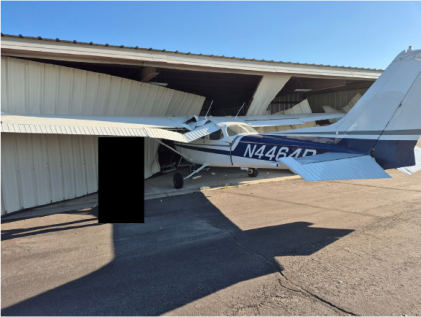
 Photograph 3 – View showing tire skid marks on ramp
 Photograph 4 – Right seat on rails, slid full forward
 Photograph 5 – Right seat on seat rails
 Photograph 6 – Right seat rail forward stop mounting hardware (Club maintenance director)
The NTSB's photographs with the NTSB's captions, at screen size. Open a picture to see it full size or to report one that should not be shown.
Documents from the investigation the NTSB's docket: the evidence folder behind the report
4 documents, released by the NTSB on July 1, 2026. View them here, or download them; the NTSB redacts some personal details before release, and this site shows the NTSB's own titles rather than its file names.
| # | Document | What it is | |
|---|---|---|---|
| 1 | Pilot/operator Aircraft Accident Report, NTSB Form 6120.1 | PDF, 10 pages | View Download |
| 2 | Memorandum for Record A�� Telephone Interview, Pilot | PDF, 2 pages | View Download |
| 3 | Memorandum for Record A�� Telephone Interview, Director of Maintenance | PDF, 2 pages | View Download |
| 4 | Photos | PDF, 7 pages · our copy | View Download |
The same docket at the NTSB · documents without a copy here are fetched from the NTSB when you open them.
Everything on this page comes from the NTSB's public records. The narrative, probable cause and findings are the NTSB's own words; the coded tables behind the report are written out in plain English, with pilots' ages, home towns and medical details left out. The documents and photographs are the NTSB's docket, shown as the NTSB released them. This site's own text never names anyone involved. A preliminary report can change; the final report usually follows one to two years later, and the page is refreshed when it does.