
Cessna 402B accident near Aguadilla, Puerto Rico, July 11, 2024
On July 11, 2024 at about 1:23 pm local time, a 1976 Cessna 402B, registered N4167G, was destroyed in an accident during approach (VFR pattern crosswind) near Aguadilla, Puerto Rico (Rafael Hernandez airport). It was a personal flight under general aviation rules (Part 91). 1 person was killed. The weather was visual conditions (good weather).
The NTSB's probable cause their words, unchanged
The pilot’s decision to operate the airplane with known maintenance discrepancies, which resulted in a total loss of right engine power. Contributing to the outcome was the pilot’s failure to maintain airspeed while returning to the airport with a single operating engine, which resulted in a loss of airplane control.
Source: NTSB aviation accident database, copy made October 5, 2026. Docket and reports at the NTSB.
What the record shows
- Date
- July 11, 2024 · about 1:23 pm local time
- Place
- Aguadilla, Puerto Rico · Rafael Hernandez · map
- Type
- Accident
- Injuries
- 1 person was killed.
- Weather
- visual conditions (good weather)
- Aircraft
- Cessna 402B NO SERIES, built 1976 · all 402Bs on the register
- Registration
- N4167G · registry record · serial 402B1214
- Damage
- Destroyed
- Flight
- Personal flight · general aviation rules (Part 91)
The NTSB's narrative final · quoted from the NTSB record
About 3 months before the accident, the twin-engine airplane underwent an annual maintenance inspection during which the mechanic identified numerous discrepancies with both engines and the airframe. The airplane was not subsequently approved for flight and the owner was provided a list of the discrepancies. The purpose of the accident flight was to relocate the airplane to another airport where the pilot planned to have the discrepancies addressed. The mechanic reported that he had advised the pilot that he needed to apply for a ferry permit from the FAA in order to complete the accident flight, but there was no evidence that the pilot had obtained one. On the day of the accident flight, air traffic control data showed that the pilot departed and climbed the airplane to about 1,500 ft mean sea level (msl). About 2 miles from the departure airport the pilot advised air traffic control of his intent to return to the departure runway due to a vibration of the right engine. The controller immediately cleared the pilot to enter the left downwind for the departure runway. The airplane then turned to the left and began a descent toward the left downwind leg of the traffic pattern. When the airplane was about a mile from the airport, the pilot reported that the airplane had an “engine failure” and that he intended to land on the departure runway, but in the opposite direction. Recorded flight track data showed that the airplane then turned directly toward the approach end of that runway and that during the final 30 seconds of track data, the airplane’s altitude and groundspeed decreased rapidly. Surveillance video captured the final few seconds of flight, and showed the airplane in a steep vertical descent and a right roll. The airplane impacted a residential area into trees, powerlines, and propane fuel tanks. After the impact, the airplane sustained significant postimpact fire damage. Postaccident examination of the airplane revealed no evidence of any preimpact mechanical malfunctions or failures of the airplane’s flight controls. Although the right engine’s fuel manifold was damaged by thermal forces, it contained visible corrosion and remains of diaphragm material when opened. Below the fuel screen at the fuel inlet within the manifold was a large quantity of debris and foreign material that was likely present before the accident. Based on the available evidence, it is possible that this contamination resulted in the total loss of engine power to the right engine that was reported by the pilot; however, given the multiple discrepancies that had been documented with the engine prior to the flight, and the extent of the post impact fire damage to the engine, it is possible that the loss of reported loss of engine power may have been due to other unresolved maintenance issues. The final recorded position showed the airplane about .3 miles the runway threshold at 200 ft msl and 73 kts groundspeed, on a heading of 209°. The Pilot’s Operating Handbook for the accident airplane model listed the minimum controllable airspeed as 82 knots indicated airspeed. Considering the wind information provided by air traffic control to the pilot of 090° at 10 knots, gusting to 14 knots, it is likely that the airplane’s airspeed likely decreased below its minimum controllable airspeed which resulted in a loss of control from which the pilot was not able to recover.
The complete narrative as the NTSB published it. The NTSB's docket holds the report as a PDF and any photographs, statements and other documents from the investigation.
The factual record from the NTSB's investigation tables, in plain English
What happened, in order
- Loss of engine power (partial) during approach (VFR pattern crosswind) defining event
- Collision with terrain or object (not controlled flight into terrain) during approach (VFR pattern downwind)
- Loss of control in flight during approach (VFR pattern crosswind)
The NTSB's findings
- Personnel issues › Action/decision › Info processing/decision › Decision making/judgment › Pilot
- Personnel issues › Task performance › Use of equip/info › Aircraft control › Pilot
- Aircraft › Aircraft oper/perf/capability › Performance/control parameters › Airspeed › Not attained/maintained
- Aircraft › Aircraft handling/service › Maintenance/inspections › Return to service › Not serviced/maintained
Pilot
- Certificate: private
- Ratings: multi-engine land; single-engine land
- Flight time: 1,200 hours in all
- Medical certificate: Class 3
- Seat: left
- Injury: fatal
The aircraft
- Airframe total time: 12,175 hours
- Last inspection: annual inspection, April 24, 2024; 2 hours since
- Maximum gross weight: 6,850 lb
- Seats: 8
- Landing gear: retractable
- Engine 1: Continental Motors TSIO-520-E (piston); 448 hours total
- Engine 2: Continental Motors TSIO-520-E (piston); 1,448 hours total
- Fire on the ground
The flight
- Departed from: BQN Aguadilla PR at 1:19 pm
- Destination: SJU San Juan PR
- Flight plan: none
- Runway 08/2, 11,702 ft by 200 ft
Weather at the time
- Light: daylight
- Wind: from 070° at 13 knots
- Visibility: 10 statute miles
- Sky: scat at 2,800 ft
- Temperature: 88°F (31°C), dew point 75°F (24°C)
- Altimeter: 30.01 inHg
- Observation at 9:50 am from TJBQ, 1 miles away
Weather report (METAR): TJBQ 111350Z 07013KT 10SM SCT028 31/24 A3001
Injuries
| Fatal | Serious | Minor | None | |
|---|---|---|---|---|
| Flight crew | 1 |
Photographs from the investigation 5 pictures from the NTSB's docket, as the NTSB released them
 Photograph 1 – Empennage
 Photograph 2 – View From Right Wing Tip
 Photograph 3 – Right Engine and Propeller
 Photograph 4 – Left Engine and Propeller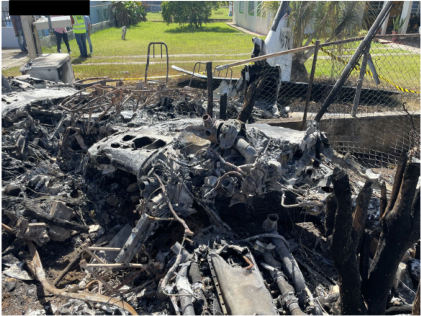
The NTSB's photographs with the NTSB's captions, at screen size. Open a picture to see it full size or to report one that should not be shown.
Documents from the investigation the NTSB's docket: the evidence folder behind the report
16 documents, released by the NTSB on May 13, 2026. View them here, or download them; the NTSB redacts some personal details before release, and this site shows the NTSB's own titles rather than its file names.
Everything on this page comes from the NTSB's public records. The narrative, probable cause and findings are the NTSB's own words; the coded tables behind the report are written out in plain English, with pilots' ages, home towns and medical details left out. The documents and photographs are the NTSB's docket, shown as the NTSB released them. This site's own text never names anyone involved. A preliminary report can change; the final report usually follows one to two years later, and the page is refreshed when it does.