
Luscombe 8 accident near Omaha, Nebraska, January 16, 2025
On January 16, 2025 at about 10:54 pm local time, a 1946 Luscombe 8, registered N71586, was substantially damaged in an accident during initial climb near Omaha, Nebraska (Millard Airport). It was a personal flight under general aviation rules (Part 91). 1 person was seriously injured. The weather was visual conditions (good weather).
The NTSB's probable cause their words, unchanged
The pilot’s inadequate preflight inspection, which resulted in a total loss of engine power due to fuel exhaustion.
Source: NTSB aviation accident database, copy made October 5, 2026. Docket and reports at the NTSB.
What the record shows
- Date
- January 16, 2025 · about 10:54 pm local time
- Place
- Omaha, Nebraska · Millard Airport · map
- Type
- Accident
- Injuries
- 1 person was seriously injured.
- Weather
- visual conditions (good weather)
- Aircraft
- Luscombe 8 A, built 1946 · all 8s on the register
- Registration
- N71586 · registry record · serial 3013
- Damage
- Substantial damage
- Flight
- Personal flight · general aviation rules (Part 91)
The NTSB's narrative final · quoted from the NTSB record
The pilot reported that while in the traffic pattern, the engine completely lost power. He switched fuel tanks, but engine power was not restored. The pilot conducted a forced landing and impacted trees. The airplane sustained substantial damage to both wings, fuselage, and empennage. Postaccident examination of the airplane revealed that the fuel tanks contained no usable fuel and the gascolator contained about a tablespoon of fuel. There was no evidence of fuel blight at the accident site. After the accident, the pilot stated that he did not sump the fuel tanks and should have checked the fuel level before the flight.
The complete narrative as the NTSB published it. The NTSB's docket holds the report as a PDF and any photographs, statements and other documents from the investigation.
The factual record from the NTSB's investigation tables, in plain English
What happened, in order
- Aircraft inspection event during prior to flight
- Off-field or emergency landing during landing
- Fuel exhaustion during initial climb defining event
The NTSB's findings
- Personnel issues › Task performance › Inspection › Preflight inspection › Pilot
- Aircraft › Fluids/misc hardware › Fluids › Fuel › Fluid level
- Environmental issues › Physical environment › Object/animal/substance › Tree(s) › Contributed to outcome
Pilot
- Certificate: private
- Ratings: single-engine land
- Flight time: 2,000 hours in all; 2,000 in this make and model
- Last flight review: August 10, 2023
- Medical certificate: Class 3 (with waivers/limitations)
- Seat: left
- Injury: serious injuries
The aircraft
- Airframe total time: 3,633.7 hours
- Last inspection: annual inspection, October 10, 2024; 1 hours since
- Maximum gross weight: 1,310 lb
- Seats: 2
- Landing gear: fixed
- Engine: Continental Motors C-90 (piston); 1,676 hours total
The flight
- Departed from: MLE Omaha NE at 10:30 pm
- Destination: MLE Omaha NE
- Flight plan: none
Weather at the time
- Light: daylight
- Visibility: 10 statute miles
- Sky: clear
- Temperature: 48°F (9°C), dew point 25°F (-4°C)
- Altimeter: 29.98 inHg
- Observation at 5:15 pm from KMLE
Weather report (METAR): METAR KMLE 162315Z AUTO 00000KT 10SM CLR 09/M04 A2998 RMK AO2 T00911045=
Injuries
| Fatal | Serious | Minor | None | |
|---|---|---|---|---|
| Flight crew | 1 |
Photographs from the investigation 2 pictures from the NTSB's docket, as the NTSB released them
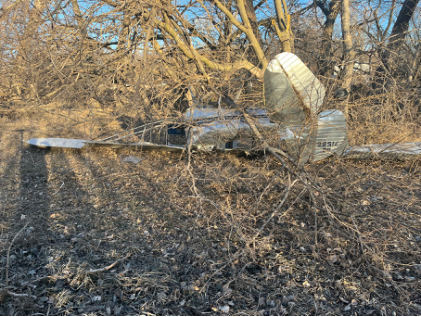
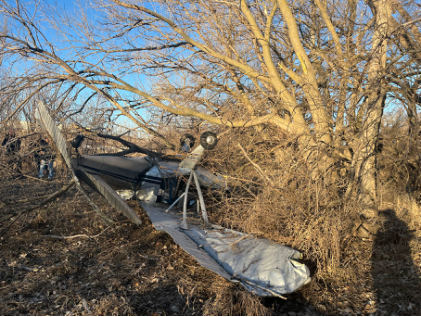
The NTSB's photographs with the NTSB's captions, at screen size. Open a picture to see it full size or to report one that should not be shown.
Documents from the investigation the NTSB's docket: the evidence folder behind the report
3 documents, released by the NTSB on April 22, 2025. View them here, or download them; the NTSB redacts some personal details before release, and this site shows the NTSB's own titles rather than its file names.
| # | Document | What it is | |
|---|---|---|---|
| 1 | Pilot/operator Aircraft Accident Report, NTSB Form 6120.1 | PDF, 10 pages | View Download |
| 2 | Investigation Photographs | PDF, 3 pages · our copy | View Download |
| 3 | Memorandum of Record A�� FAA | PDF, 1 page | View Download |
The same docket at the NTSB · documents without a copy here are fetched from the NTSB when you open them.
Everything on this page comes from the NTSB's public records. The narrative, probable cause and findings are the NTSB's own words; the coded tables behind the report are written out in plain English, with pilots' ages, home towns and medical details left out. The documents and photographs are the NTSB's docket, shown as the NTSB released them. This site's own text never names anyone involved. A preliminary report can change; the final report usually follows one to two years later, and the page is refreshed when it does.