
Amateur-built ZODIAC 601XLB accident near Dunbar, Pennsylvania, April 27, 2024
On April 27, 2024 at about 11:43 pm local time, a 2015 amateur-built ZODIAC 601XLB, registered N601DR, was destroyed in an accident during landing near Dunbar, Pennsylvania (Joseph A Hardy Connellsville airport). It was a flight test under general aviation rules (Part 91). No one was hurt; 1 person was on board or involved. The weather was visual conditions (good weather).
The NTSB's probable cause their words, unchanged
A total loss of engine power as a result of an improperly fabricated fuel-air mixture cable bracket. Contributing was the pilot’s decision to fly the airplane with a known mechanical engine issue, and the presence of another airplane that was back taxiing on the runway while the pilot was attempting to maneuver the airplane for landing.
Source: NTSB aviation accident database, copy made October 5, 2026. Docket and reports at the NTSB.
What the record shows
- Date
- April 27, 2024 · about 11:43 pm local time
- Place
- Dunbar, Pennsylvania · Joseph A Hardy Connellsville · map
- Type
- Accident
- Injuries
- No one was hurt; 1 person was on board or involved.
- Weather
- visual conditions (good weather)
- Aircraft
- Amateur-built ZODIAC 601XLB, built 2015
- Registration
- N601DR · registry record · serial 6-5554
- Damage
- Destroyed
- Flight
- Flight test · general aviation rules (Part 91)
The NTSB's narrative final · quoted from the NTSB record
The pilot reported that the purpose of the flight was to test cooling plenum changes that he had recently made to the experimental amateur-built airplane’s automotive conversion engine. After takeoff on the planned flight in the airport traffic pattern, the pilot heard over the radio that another airplane was inbound to the airport for touch-and-go landings, so he flew away from the airport and performed ground reference maneuvers. Shortly after, the pilot returned to the traffic pattern, entering on the upwind leg. Upon turning onto the crosswind leg, his engine began to “sputter”, so he made a 180° turn to land on the opposite direction of the same runway. About that time, he noticed that the other airplane was back taxiing on the runway. He elected to not land on the parallel taxiway due to its condition and out of concern for a possible collision with another aircraft. The pilot overflew the other airplane on the runway, and shortly thereafter his airplane’s engine lost power completely as he neared the end of the runway. About that time the pilot was turning the airplane left, but could feel it slowing, so he leveled the wings and landed straight ahead, perpendicular to the runway. The airplane subsequently traveled over a grass embankment and contacted trees, resulting in substantial damage to the right wing and fuselage structure. The pilot stated that following the accident, an examination of the engine revealed that a bracket for the fuel/air mixture cable had “bent and overextended,” which resulted in the engine’s fuel/air mixture becoming excessively lean. The pilot stated that he had fabricated the bracket during a recent engine replacement and knew that a new bracket would need to be refabricated but had not completed the task it before the accident flight. Based on this information, it is likely that the loss of engine power was the result of the improperly fabricated bracket, which resulted in an excessively lean mixture to the airplane’s engine.
The complete narrative as the NTSB published it. The NTSB's docket holds the report as a PDF and any photographs, statements and other documents from the investigation.
The factual record from the NTSB's investigation tables, in plain English
What happened, in order
- Loss of engine power (total) during landing defining event
- Collision with terrain or object (not controlled flight into terrain) during landing (landing roll)
- Off-field or emergency landing during emergency descent
The NTSB's findings
- Aircraft › Aircraft power plant › Engine controls › Mixture control › Design
- Personnel issues › Task performance › Maintenance › Fabrication › Pilot
- Personnel issues › Action/decision › Info processing/decision › Decision making/judgment › Pilot
- Environmental issues › Physical environment › Object/animal/substance › Aircraft › Contributed to outcome
Pilot
- Certificate: private
- Ratings: single-engine land
- Flight time: 258 hours in all; 203 in this make and model; 1 in the last 90 days; 1 in the last 30 days; 197 as pilot in command
- Last flight review: April 13, 2022
- Medical certificate: Class 3 (without waivers/limitations)
- Seat: left
- Injury: no injuries
The aircraft
- Airframe total time: 360.1 hours
- Last inspection: condition inspection, March 18, 2022; 1.5 hours since
- Maximum gross weight: 1,320 lb
- Seats: 2
- Landing gear: fixed
- Engine: Azalea Aviation 100HP (piston); 2 hours total
The flight
- Flight plan: none
- Runway 05/2, 3,833 ft by 100 ft
Weather at the time
- Light: daylight
- Wind: from 100° at 3 knots
- Visibility: 15 statute miles
- Sky: clear
- Temperature: 61°F (16°C), dew point 54°F (12°C)
- Altimeter: 30.16 inHg
- Observation at 7:51 pm from LBE, 18 miles away
Weather report (METAR): KLBE 272351Z 10003KT 15SM CLR 16/12 A3016
Injuries
| Fatal | Serious | Minor | None | |
|---|---|---|---|---|
| Flight crew | 1 |
Photographs from the investigation 1 picture from the NTSB's docket, as the NTSB released them
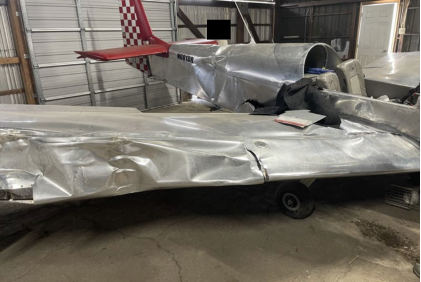
The NTSB's photographs with the NTSB's captions, at screen size. Open a picture to see it full size or to report one that should not be shown.
Documents from the investigation the NTSB's docket: the evidence folder behind the report
6 documents, released by the NTSB on November 22, 2024. View them here, or download them; the NTSB redacts some personal details before release, and this site shows the NTSB's own titles rather than its file names.
| # | Document | What it is | |
|---|---|---|---|
| 1 | Pilot/operator Aircraft Accident Report, NTSB Form 6120.1 | PDF, 11 pages | View Download |
| 2 | Memorandum for Record A�� Telephone Interview, Pilot | PDF, 3 pages | View Download |
| 3 | Cap Instructor Interview | PDF, 2 pages | View Download |
| 4 | Cap Student Receiving Instruction Interview | PDF, 2 pages | View Download |
| 5 | Witness Statements | PDF, 5 pages | View Download |
| 6 | Investigative Photos | PDF, 2 pages · our copy | View Download |
The same docket at the NTSB · documents without a copy here are fetched from the NTSB when you open them.
Everything on this page comes from the NTSB's public records. The narrative, probable cause and findings are the NTSB's own words; the coded tables behind the report are written out in plain English, with pilots' ages, home towns and medical details left out. The documents and photographs are the NTSB's docket, shown as the NTSB released them. This site's own text never names anyone involved. A preliminary report can change; the final report usually follows one to two years later, and the page is refreshed when it does.