
Hughes 369HS accident near Durango, Colorado, May 7, 2026
On May 7, 2026 at about 6:30 pm local time, a 1974 Hughes 369HS (helicopter), registered N926ES, was substantially damaged in an accident near Durango, Colorado (Durango-La Plata County airport). It was an instructional flight under general aviation rules (Part 91). No one was hurt; 2 people were on board or involved. The weather was visual conditions (good weather).
Preview. This page is not yet listed for search engines.
The NTSB's probable cause their words, unchanged
The flight instructor’s inadequate supervision of the pilot receiving the instruction and the pilot’s improper recovery from a practice autorotation in shifting wind conditions, which resulted in a hard landing.
Source: NTSB aviation accident database, copy made October 4, 2026. Docket and reports at the NTSB.
What the record shows
- Date
- May 7, 2026 · about 6:30 pm local time
- Place
- Durango, Colorado · Durango-La Plata County · map
- Type
- Accident
- Injuries
- No one was hurt; 2 people were on board or involved.
- Weather
- visual conditions (good weather)
- Aircraft
- Hughes 369HS, built 1974 · all 369HSs on the register
- Registration
- N926ES · registry record · serial 940641S
- Damage
- Substantial damage
- Flight
- Instructional flight · general aviation rules (Part 91)
The NTSB's narrative final · quoted from the NTSB record
While conducting an instructional flight, the flight instructor reported that the pilot receiving instruction was performing practice autorotations in the helicopter. He stated that wind conditions were light and variable. During the accident practice straight-in autorotation, the pilot receiving instruction stated that he overshot the intended landing point and began slowing the helicopter. As the helicopter slowed to about 30 knots, he then lowered the nose to regain airspeed. He reported that the rotor RPM was on the low side of the green arc and that the airspeed was about 60 knots. During the flare, about 10 ft, both the pilot and flight instructor simultaneously raised the collective in attempt to cushion the landing. However, the helicopter continued to sink and landed hard. The skids collapsed and the helicopter slid about 100 ft before it came to rest upright on the taxiway. The helicopter’s tail boom and one of the main rotor blades separated during the accident sequence. Both the instructor and pilot stated that the wind had shifted opposite to the direction the windsock was indicating at the time of the accident. Wind recorded at the time of the accident was light and variable at 4 knots. The flight instructor reported that there were no preimpact mechanical malfunctions or failures that would have precluded normal operations.
The complete narrative as the NTSB published it. The NTSB's docket holds the report as a PDF and any photographs, statements and other documents from the investigation.
The factual record from the NTSB's investigation tables, in plain English
What happened, in order
- Autorotation Hard landing defining event
- Simulated/training event during approach
The NTSB's findings
- Personnel issues › Task performance › Use of equip/info › Aircraft control › Pilot
- Aircraft › Aircraft oper/perf/capability › Performance/control parameters › Pitch control › Not attained/maintained
- Personnel issues › Psychological › Attention/monitoring › Monitoring other person › Instructor/check pilot
- Environmental issues › Conditions/weather/phenomena › Wind › Sudden wind shift › Effect on operation
Pilot
- Certificate: flight instructor, commercial pilot
- Ratings: single-engine land; instructor: helicopter; instrument: helicopter; rotorcraft: helicopter
- Flight time: 10,634 hours in all; 9,006.8 in this make and model; 63.7 in the last 90 days; 8.9 in the last 30 days; 10,577 as pilot in command; 6,625.7 on instruments
- Last flight review: October 1, 2025
- Medical certificate: Class 2 (with waivers/limitations)
- Seat: rgt
- Injury: unkn
Pilot
- Certificate: flight instructor, commercial pilot
- Ratings: instructor: helicopter; instructor: instrument helicopter; instrument: helicopter; rotorcraft: helicopter
- Flight time: 453 hours in all; 140 in this make and model; 96 in the last 90 days; 37 in the last 30 days; 368 as pilot in command; 146 on instruments
- Last flight review: September 9, 2025
- Medical certificate: Class 2 (without waivers/limitations)
- Seat: left
- Injury: no injuries
The aircraft
- Airframe total time: 6,581.6 hours
- Last inspection: annual inspection, February 1, 2026
- Maximum gross weight: 2,550 lb
- Seats: 4
- Landing gear: fixed
- Engine: Allison 250 SER 400HP (turboshaft); 65,542 hours total
The flight
- Departed from: 00C Durango CO at 5:30 pm
- Flight plan: none
- A second pilot was aboard
Weather at the time
- Light: daylight
- Visibility: 10 statute miles
- Sky: clear
- Temperature: 57°F (14°C), dew point 14°F (-10°C)
- Altimeter: 30.18 inHg
- Observation at 12:00 pm from KDRO, 1 miles away
Weather report (METAR): METAR KDRO 071753Z AUTO VRB04KT 10SM CLR 14/M10 A3018 RMK AO2 SLP193 T01391100 10144 21061 58015
Injuries
| Fatal | Serious | Minor | None | |
|---|---|---|---|---|
| Flight crew | 2 |
Photographs from the investigation 1 picture from the NTSB's docket, as the NTSB released them
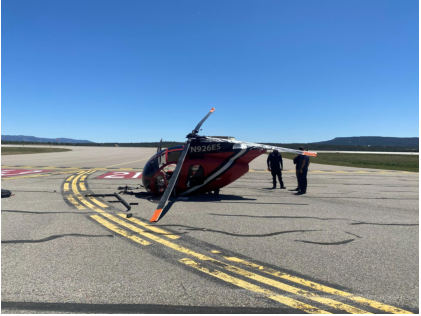
The NTSB's photographs with the NTSB's captions, at screen size. Open a picture to see it full size or to report one that should not be shown.
Documents from the investigation the NTSB's docket: the evidence folder behind the report
3 documents, released by the NTSB on September 17, 2026. View them here, or download them; the NTSB redacts some personal details before release, and this site shows the NTSB's own titles rather than its file names.
| # | Document | What it is | |
|---|---|---|---|
| 1 | Photos | PDF, 2 pages · our copy | View Download |
| 2 | Pilot/operator Aircraft Accident Report, NTSB Form 6120.1 | PDF, 10 pages | View Download |
| 3 | Instructor Aircraft Accident Report, NTSB Form 6120.1 | PDF, 10 pages | View Download |
The same docket at the NTSB · documents without a copy here are fetched from the NTSB when you open them.
About this page
Everything above comes from the NTSB's public accident database: the narrative, probable cause and findings are the NTSB's own words, and the coded tables behind its report (pilot, aircraft, flight, weather, injuries, sequence of events) are written out in plain English. Pilots' ages, home towns and medical details are left out on purpose. The documents and photographs are the NTSB's docket, the folder of records gathered during the investigation, shown as the NTSB released them (the NTSB redacts some personal details first) and listed under the NTSB's own titles. This site's own text never names pilots, passengers or anyone else involved. A preliminary report describes what is known soon after the event and can change; the final report, with the probable cause, usually follows one to two years later and this page is refreshed when it does. Case number CEN26LA181.