
Piper PA31 accident near Lemoore, California, June 18, 2024
On June 18, 2024 at about 5:00 pm local time, a 1976 Piper PA31, registered CGJBG, was substantially damaged in an accident during enroute (cruise) near Lemoore, California (Lemoore airport). It was an aerial observation flight under general aviation rules (Part 91). 2 people had minor injuries. The weather was visual conditions (good weather).
The NTSB's probable cause their words, unchanged
The pilot’s improper in-flight decision making which resulted in a total loss of engine power due to fuel exhaustion and a subsequent emergency landing.
Source: NTSB aviation accident database, copy made October 5, 2026. Docket and reports at the NTSB.
What the record shows
- Date
- June 18, 2024 · about 5:00 pm local time
- Place
- Lemoore, California · Lemoore · map
- Type
- Accident
- Injuries
- 2 people had minor injuries.
- Weather
- visual conditions (good weather)
- Aircraft
- Piper PA31, built 1976 · all PA31s on the register
- Registration
- CGJBG · no longer on the register · serial 31-7612033
- Damage
- Substantial damage
- Flight
- Aerial observation flight · general aviation rules (Part 91)
The NTSB's narrative final · quoted from the NTSB record
The left-seated pilot stated that she was recently hired with the operator and was new to flying survey operations. The right-seated pilot was training her for survey operations. They filed a flight plan for a 5-hour survey flight and filled the fuel tanks full. After takeoff, the fuel selector was set to the outboard tanks and after 1 hour and 50 minutes, the inboard tanks were selected. After another 2 hours and 20 minutes, the pilot noticed lower-than-expected fuel on the gauges and opted to end the flight early. Approximately 10 minutes after turning back, the engines had intermittent power loss and were sputtering due to low fuel. The pilot made a request to land at a nearby Naval Base and declared an emergency. The controller communicated runway 14L was closed. The pilot approached runway 14R and noticed people and objects on the runway. They were redirected to land on another runway, but the airplane was too low and touched down on grass. The airplane continued the landing roll into a security fence, damaging the fuselage and both wings. The pilot reported there were no pre-impact mechanical malfunctions or failures that precluded normal operation.
The complete narrative as the NTSB published it. The NTSB's docket holds the report as a PDF and any photographs, statements and other documents from the investigation.
The factual record from the NTSB's investigation tables, in plain English
What happened, in order
- Wrong surface or wrong airport during approach
- Fuel related during enroute (cruise) defining event
- Fuel exhaustion during emergency descent
- Course deviation during approach (VFR pattern final)
- Landing area undershoot during landing
The NTSB's findings
- Personnel issues › Task performance › Planning/preparation › Fuel planning › Pilot
- Personnel issues › Task performance › Use of equip/info › Use of equip/system › Pilot
- Personnel issues › Action/decision › Info processing/decision › Identification/recognition › Pilot
- Personnel issues › Action/decision › Info processing/decision › Decision making/judgment › Pilot
- Aircraft › Fluids/misc hardware › Fluids › Fuel › Fluid level
Pilot
- Certificate: commercial pilot
- Ratings: multi-engine land; instrument: airplane
- Flight time: 1,216 hours in all; 388 in this make and model; 62 in the last 90 days; 26 in the last 30 days; 686 as pilot in command
- Last flight review: September 1, 2023
- Medical certificate: Class 1 (without waivers/limitations)
- Seat: left
- Injury: minor injuries
Co-pilot
- Certificate: commercial pilot
- Ratings: multi-engine land
- Flight time: 400 hours in all; 45 in this make and model; 53 in the last 90 days; 10 in the last 30 days; 200 as pilot in command
- Medical certificate: Class 1 (without waivers/limitations)
- Seat: rgt
- Injury: minor injuries
The aircraft
- Airframe total time: 12,384.9 hours
- Last inspection: 100-hour inspection, May 10, 2024
- Maximum gross weight: 6,840 lb
- Seats: 2
- Landing gear: retractable
- Engine 1: Lycoming T10-540-A2B (turboprop); 0 hours total
- Engine 2: Lycoming T10-540-A2B (turboprop); 0 hours total
The flight
- Departed from: MAE Madera CA at 12:30 pm
- Flight plan: VFR
- Runway 14L, 13,502 ft by 200 ft
- A second pilot was aboard
Weather at the time
- Light: daylight
- Wind: from 320° at 13 knots, gusting 19
- Visibility: 10 statute miles
- Sky: a few clouds at 20,000 ft
- Temperature: 79°F (26°C), dew point 36°F (2°C)
- Altimeter: 29.81 inHg
- Observation at 9:56 am from KNLC, 2 miles away
Weather report (METAR): KNLC 181656Z 32013G19KT 10SM FEW200 26/02 A2981 RMK SLP093 RH/20 T02610017
Injuries
| Fatal | Serious | Minor | None | |
|---|---|---|---|---|
| Flight crew | 2 |
Photographs from the investigation 1 picture from the NTSB's docket, as the NTSB released them
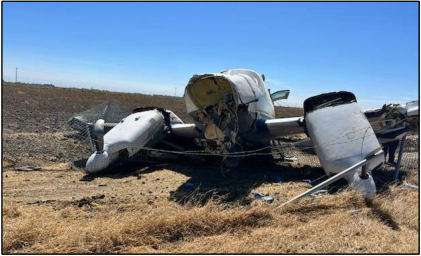
The NTSB's photographs with the NTSB's captions, at screen size. Open a picture to see it full size or to report one that should not be shown.
Documents from the investigation the NTSB's docket: the evidence folder behind the report
2 documents, released by the NTSB on February 12, 2025. View them here, or download them; the NTSB redacts some personal details before release, and this site shows the NTSB's own titles rather than its file names.
| # | Document | What it is | |
|---|---|---|---|
| 1 | Pilot/operator Aircraft Accident Report, NTSB Form 6120.1 | PDF, 9 pages | View Download |
| 2 | Photograph from Accident Site (Provided by Airport Manager) | PDF, 1 page · our copy | View Download |
The same docket at the NTSB · documents without a copy here are fetched from the NTSB when you open them.
Everything on this page comes from the NTSB's public records. The narrative, probable cause and findings are the NTSB's own words; the coded tables behind the report are written out in plain English, with pilots' ages, home towns and medical details left out. The documents and photographs are the NTSB's docket, shown as the NTSB released them. This site's own text never names anyone involved. A preliminary report can change; the final report usually follows one to two years later, and the page is refreshed when it does.